Mischievous Scrivener!
What medieval scribes teach us about creativity and the legacy of work
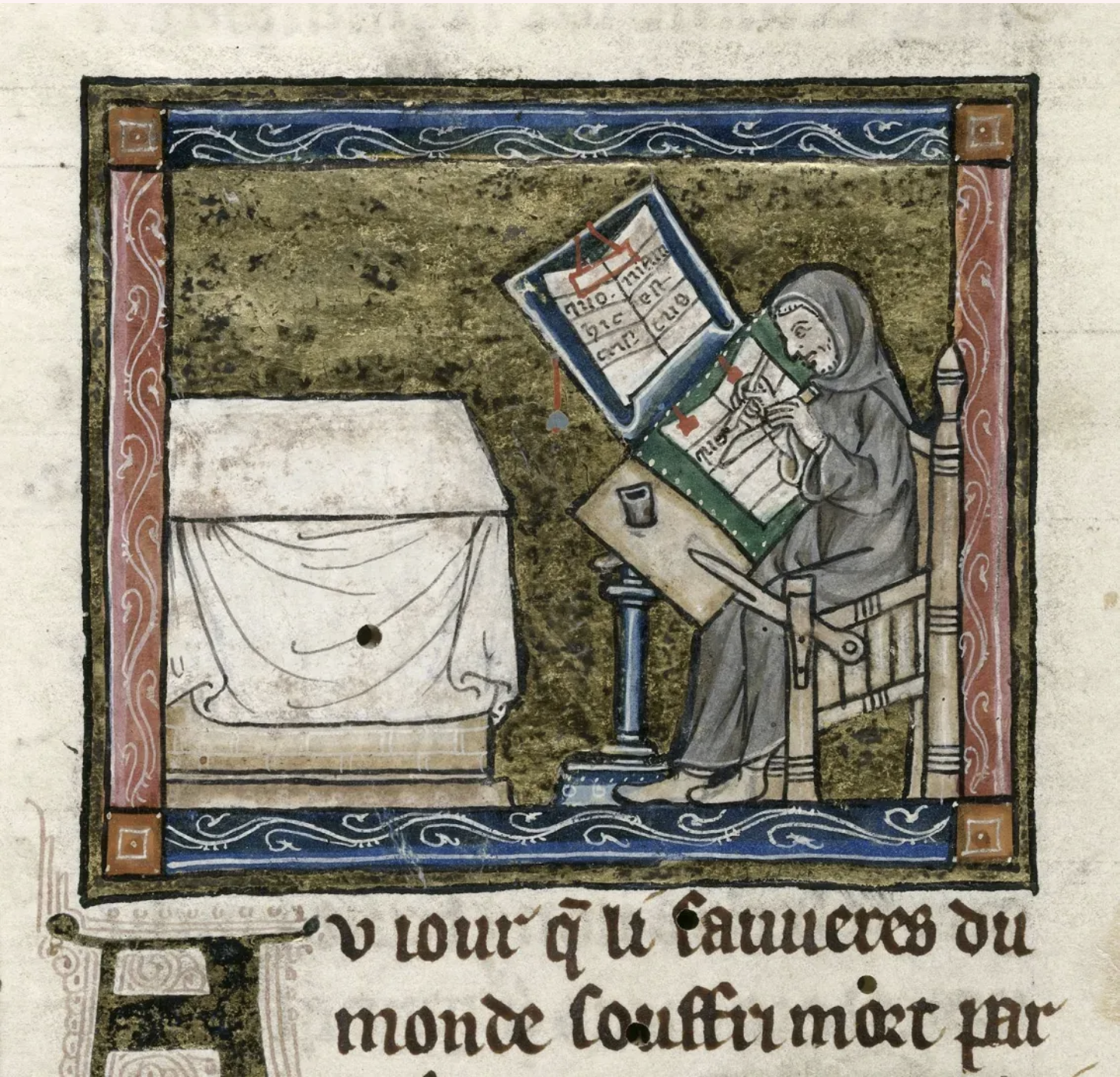
Figure 2. Scribe at work, pen and knife in hand (London, British Library, Royal 14 E.iii, 14th century). Source
Before the printing press revolutionized the literary industry, the production of a physical book was almost as labor intensive and personal as the writing of the text it contained. Such work fell to armies of scribes: mostly monks, but also nuns and secular craftsmen, whose job it was to copy texts into new manuscripts so that they could be read by more than one person. The Medieval scriptorium, or manuscript workshop, was often vast and almost industrial in its operation, where tens of copyists could be simultaneously responsible for working on different parts of a single manuscript. Ostensibly, these scribes’ assignment was clear: they were to produce as exact a replica of the exemplar that they were copying as possible. However, in practice, these people were far from mere cogs in the greater machine of the scriptorium. They imbued the manuscripts that they produced with indelible aspects of their own individuality, and often turned what was supposed to be a routine, passive job into a collaborative creative process. The scribes, it turns out, hold a remarkable power over our modern perception of Medieval culture, thought patterns, and literature.
Scribal humanity has many ways of seeping through in any manuscript one can examine. Some of these idiosyncrasies were unintentional: scribes would occasionally make errors, often scratching out or scraping off their mistakes and leaving visible traces of their relatable fallibility. However, many scribal changes were intentional, and provide an even greater window into their cognitions and, more broadly, into the evolution of Medieval language and society.
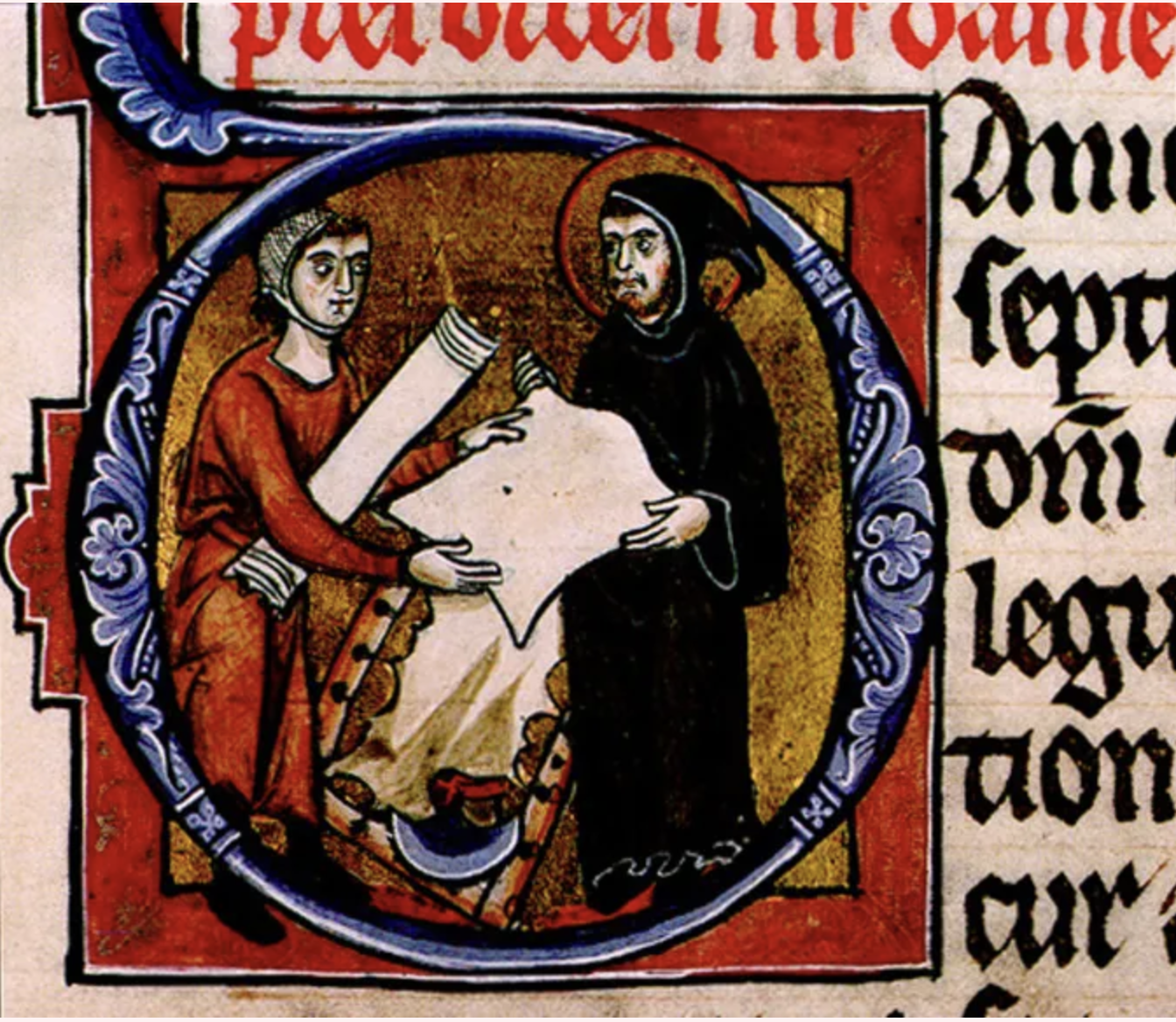
For many texts that were copied over a long period of time, scribes would actively adapt the language of their example text into a phrasing or linguistic pattern in keeping with their own contemporary dialect. This kind of updating was frowned upon by authors; for example, the prolific English scholar Ælfric of Eynsham wrote in the preface of his first volume of Catholic Homilies, “Now I ask…if anyone wishes to copy this book, that he diligently correct it according to the exemplar…much evil does the one who writes falsely, unless he corrects it, as if he brings the true teaching to false error. Therefore, every person must rectify that which he earlier turned to error, if he wishes to be innocent in God’s judgement” (trans. Amos van Baalen).
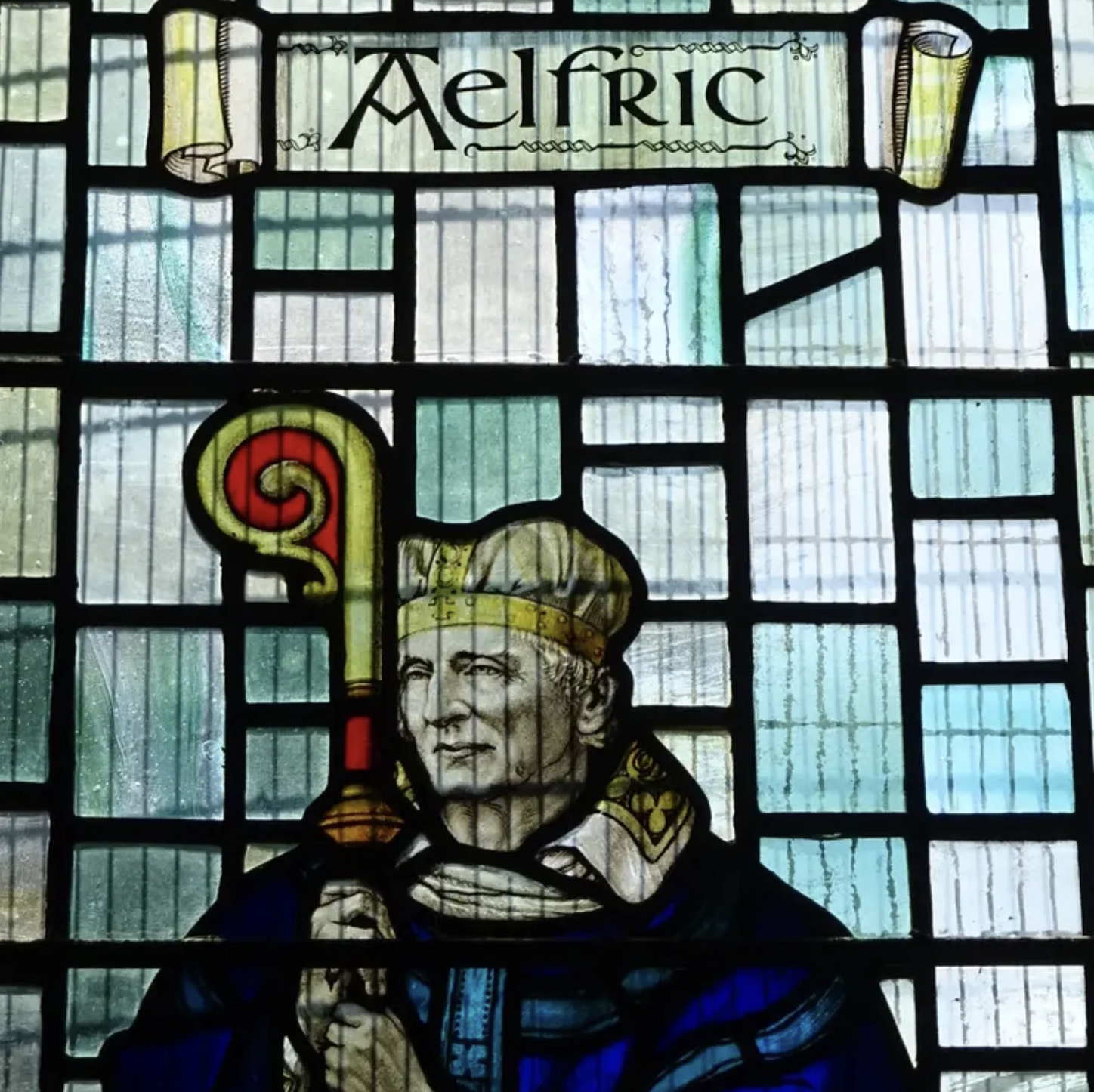
Stained glass representation of Ælfric in an Anglican church (via Clerk of Oxford)
However, one must remember that language evolves in ways that would seem very significant to contemporary readers, even if not to most people looking back over many centuries. A two-hundred year interval, which was the length of time that the aforementioned Ælfric’s works were primarily copied, would set modern readers back to 1826. The average text from those years, while comprehensible, would likely give a modern reader pause over some antiquated terminology or phrasing. Some manuscripts had an even longer copying life than Ælfric’s, and one can assume that the greater the distance between author and scribe, the greater the impulse would be to amend the text.
Other times, manuscripts were edited with no clear modernizing agenda guiding the modifications. In these instances, it seems to be mainly creative liberty that shapes the edits. This would make the scribe a sort of author in their own right, the creator of the latest edition of a text. In this way, we can see the influence that scribes wield over our understanding of literature from this period: the nameless transcriber assumes a voice that they would not have been granted in a highly stratified society, and is in the unique position of anonymously broadcasting that voice to both contemporary and future readers.
Perhaps my favorite instance of scribal modifications aren’t linguistic at all, but rather, visual. Doodling, a universal pastime of the bored or procrastinating, is certainly not limited to the modern era. Many seemingly random drawings can be found in manuscripts. While some are thought to be simple doodles, perhaps induced by the repetitive nature of their task, others are believed to have been carefully designed exercises to test a quill. Quills were trimmed with knives, and had to be adjusted every so often as they became dull. Many of these doodles are thought to have been designed to test whether the pen nib was the right thickness.
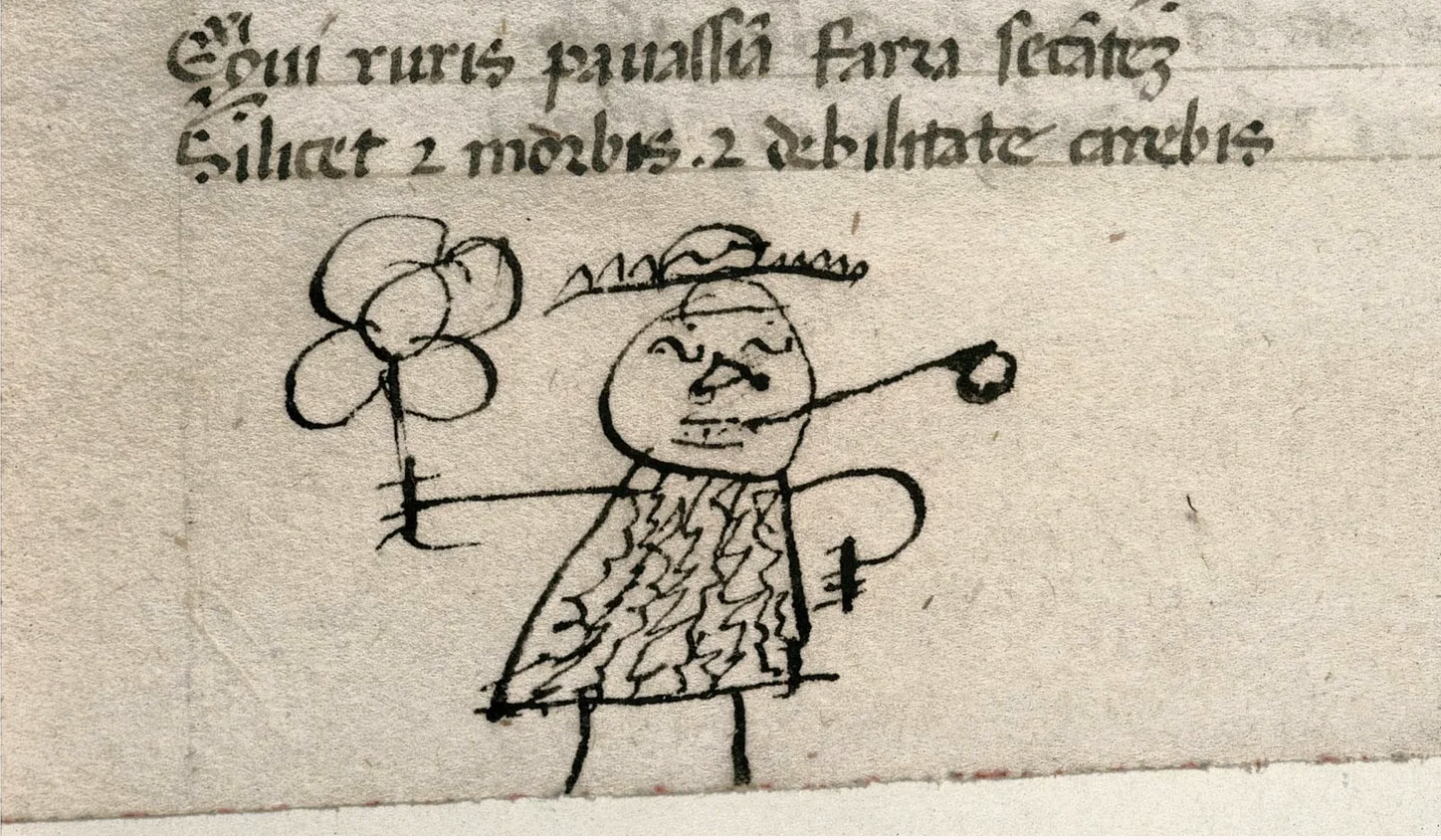
Figure 1. Doodle in the lower margin of a medieval page (Carpentras, Bibliothèque municipale, 368 (15th century). Source
However, although practical in nature, many scribal pen trials are more ornate than the ostensible task would have required. This provides a look into the creativity and individuality of Medieval scribes. So often forced to routinely copy the work of others, pen trials might have served a unique opportunity for a bored scribe to release some of his own pent-up creative energy and create modest original artworks.
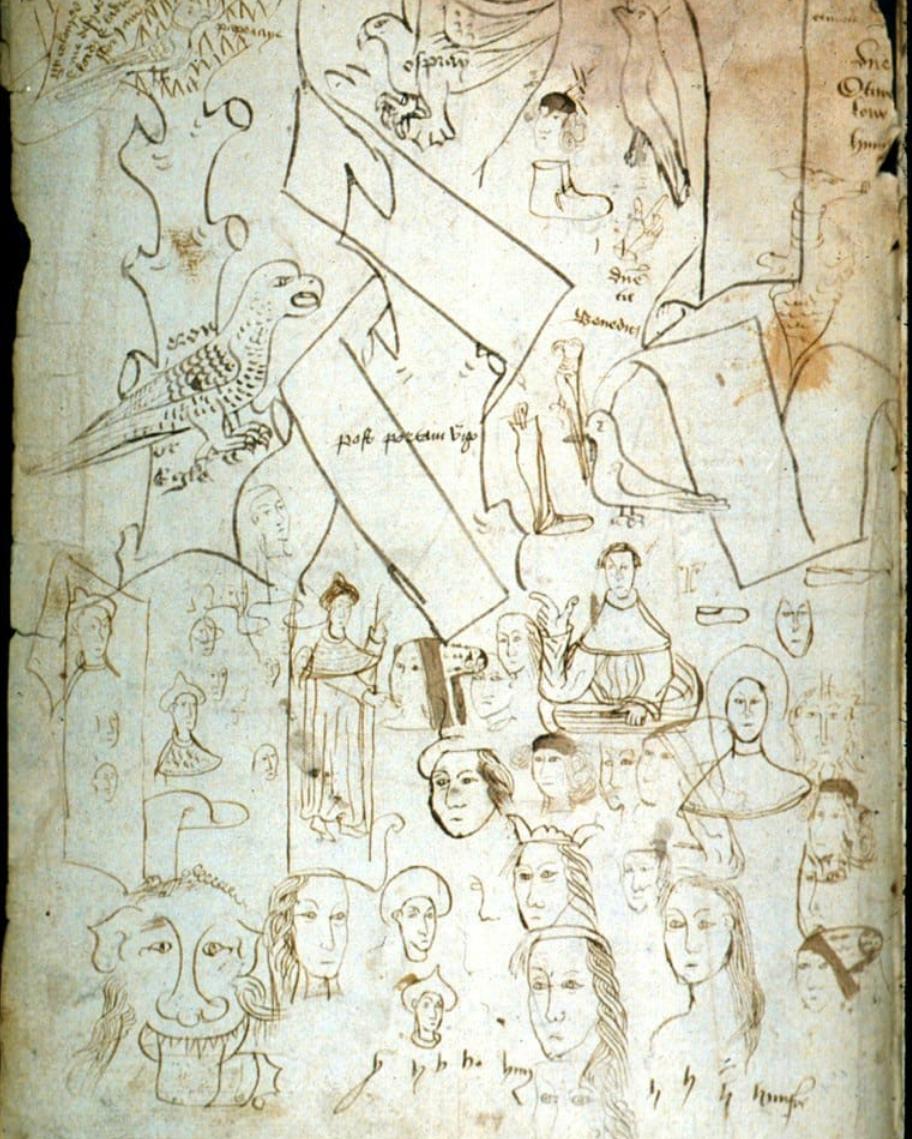
Oxford, Bodleian Library, Lat. misc. c. 66 (15th century)
In the same manuscript, many different scribes would often work in tandem on separate leaves. Among groups of scribes, we see very different pen test styles that expose some of the scribes’ individuality and personal interests, just as people today often have signature doodling styles. Some scribes draw people, others animals. Some test their pens practically, using words (such as the apt “probatio pennae”, I test my pen), while others even scratch out musical notation. Others express their creativity in other, more obscene ways, such as one scribe replacing the typical manicule (a pointing finger icon that appears regularly to highlight a significant passage), with a disembodied penis. In an era when most art was supposed to be religious in nature, doodling offers a window into other aspects of the medieval consciousness. Some doodles even veer into the blasphemous, with crude images such as naked bishops appearing in the margins of manuscripts.
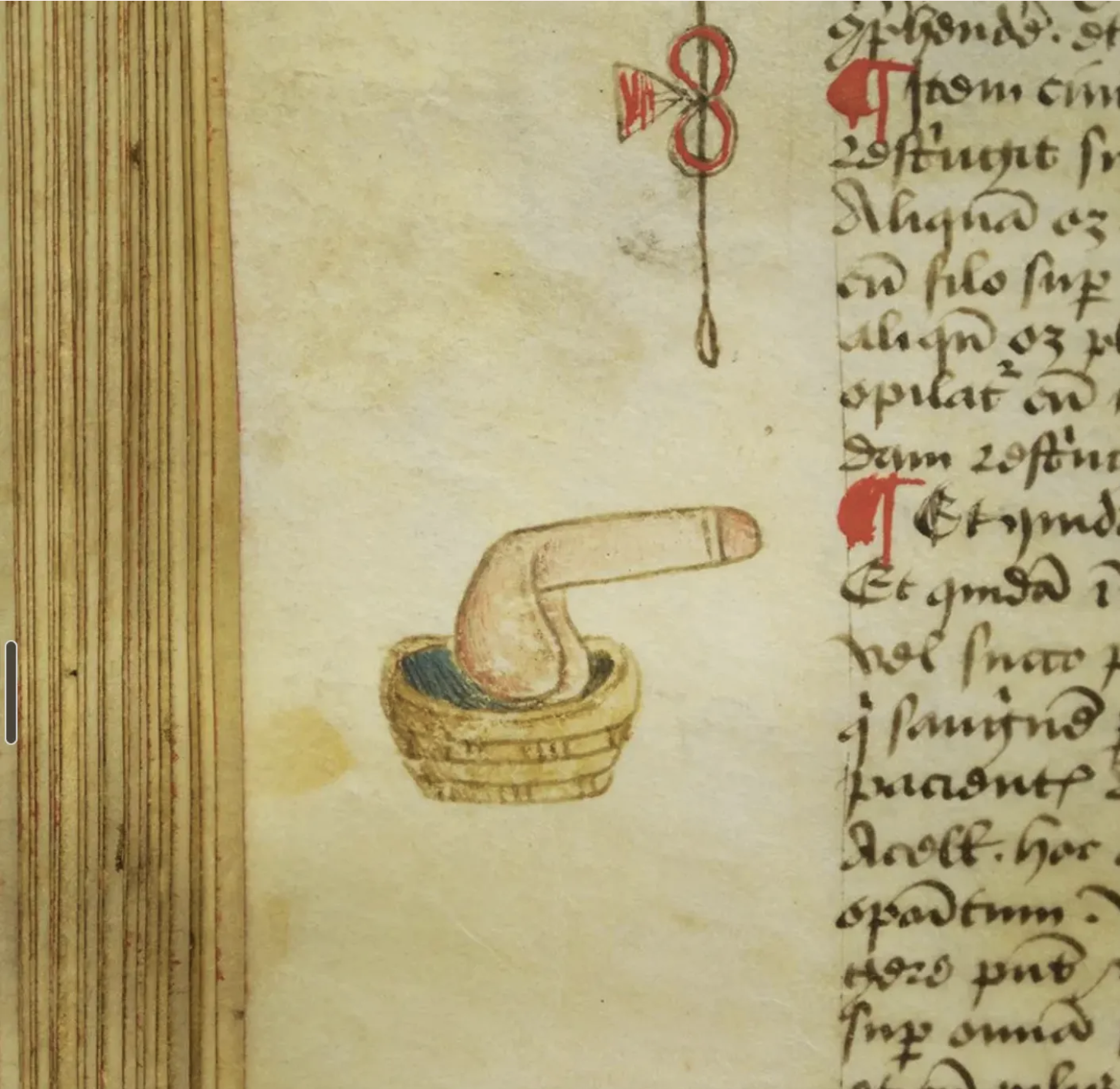
A disembodied penis in a basket in the margin’s of Arderne’s treatise. Glasgow University Library MS Hunter 251 (U.4.9)
These instinctive sketches provide one of the most unedited, relatable, and direct lenses we have into the stream of consciousness of people living hundreds of years ago. What was on this particular scribe’s mind that day? Were they a serious, scholarly type, or were they more inclined to levity and joking around?
It would be easy to consider the thousands of scribes that literally penned the manuscripts we study today as vehicles, not individuals: cogs in a machine that carried knowledge to us across centuries. But can this be said if each “cog” left an inextricable thread of themselves in the text that they conveyed?
The history of scribal entanglement is not merely a historical curiosity. Their persistent tendency to personalize even the most repetitive labor raises broader questions about the ways in which humans engage with the meaning in their work. Today, we live in a society in which those that control the means of production in our society naturally encourage optimization and productivity in the workers that facilitate economic advancement. This focus on productivity shapes so much of our lives and social systems. As someone both actively involved in the educational system myself, and who spends quite a bit of time thinking and writing about educational theory, I see the focus that academic institutions put on measurable achievement, leaving students desperately striving for high grades and test scores. Additionally, especially in language learning, routine memorization is often the main tool used to teach students how to formulate sentences and translate correctly. I do not disagree that these methods have their place. However, when I reflect on the most impactful learning experiences I’ve ever had, they were more personal: discussions, experiments, techniques that invited the student to be creative and allowed their interest to guide the direction of learning.
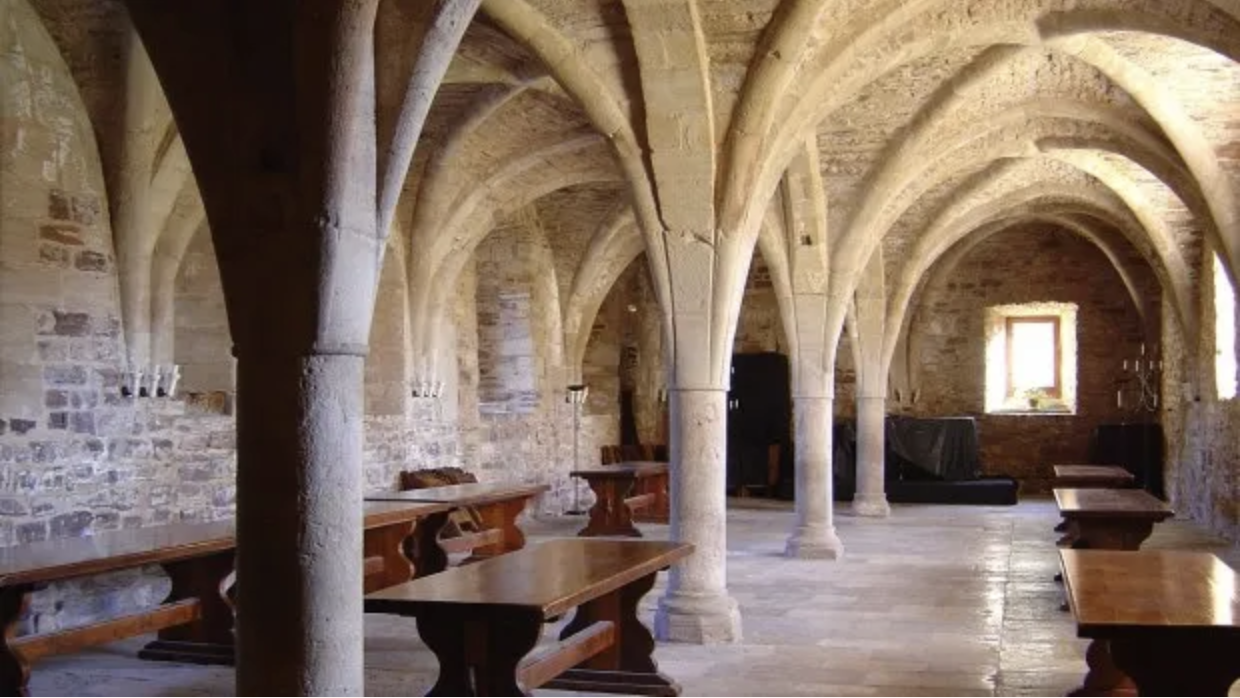
The scriptorium of the Abbey of Sylvanès in France (via Pons de Léras | CC BY-SA 4.0)
Medieval scriptoriums were highly efficient and structured places, and yet the most fascinating legacies they’ve left behind are found in the moments where personality accompanied the perfectly copied words. Individual scribes, even whole scriptoriums, would have faded into anonymity if not for the personal creativity and inventiveness that crept into the superficially routine tasks. These scribes show us that humans naturally seek inventiveness and authorship even in repetitive labor. Modern workplaces and schools prioritize output, but this approach runs the risk of reducing each worker to a set of quotas and statistics, ones that will fade and disappear into the file cabinets of history. Creativity and individual expression is what makes work memorable, meaningful, and timeless.
This becomes especially important when considering the rise in burnout and professional and academic frustration in recent years. Chronic stress and disillusionment with the significance of individual work has become an epidemic of the modern era. Surveys suggest that over 75% of American workers experiencing some form of burnout, and younger generations are the most significantly impacted. I think that it could be wise to look to the medieval scribes for a remedy. Their task was arguably the most mechanical and least personal assignment one could devise; they were intended to be a step in the process of book production that would disappear, leaving only author and reader. And yet, they rejected the total anonymity imposed upon them. They introduced humor, imagination, and a window into their inner world that can tell us just as much about history and humanity as the texts that they were copying. Replication was their craft, but originality and humanity was their ultimate legacy.
Bibliography:
Boodts, Shari. “Who were these people copying manuscripts? The mysteries of medieval scribes.” Medievalists.net, 26 December 2021, https://www.medievalists.net/2021/12/people-copying-manuscripts-medieval-scribes/. Accessed 23 June 2026.
Burgess, Anika. “The Strange and Grotesque Doodles in the Margins of Medieval Books.” Atlas Obscura, 9 May 2017, https://www.atlasobscura.com/articles/medieval-marginalia-books-doodles. Accessed 22 June 2026.
Kwakkel, Erik. “Doodles in Medieval Manuscripts.” medievalbooks, 5 October 2018, https://medievalbooks.nl/2018/10/05/doodles-in-medieval-manuscripts/. Accessed 22 June 2026.
Porck, Thijs. “Scribal abuse in the Middle Ages – Thijs Porck.” Thijs Porck, 14 January 2016, https://thijsporck.com/2016/01/14/scribal-abuse-in-the-middle-ages/. Accessed 22 June 2026.
Robinson, Bryan. “Job Burnout At 66% In 2025, New Study Shows.” Forbes, 8 February 2025, https://www.forbes.com/sites/bryanrobinson/2025/02/08/job-burnout-at-66-in-2025-new-study-shows/. Accessed 24 June 2026.
“Scribal Errors and Corrections.” Medieval Writing, https://medievalwritings.atillo.com.au/tools/errors.htm. Accessed 22 June 2026.
van Baalen, Amos. “Medieval Copying Gone Wrong? The Importance of Scribal Interference.” Leiden Medievalists Blog, 2021, https://www.leidenmedievalistsblog.nl/articles/medieval-copying-gone-wrong.